
Industrial automation applications
Robotic Machine Tending
Robotic machine tending reduces repetitive handling and keeps process equipment supplied with correctly oriented parts through a controlled, recoverable sequence.
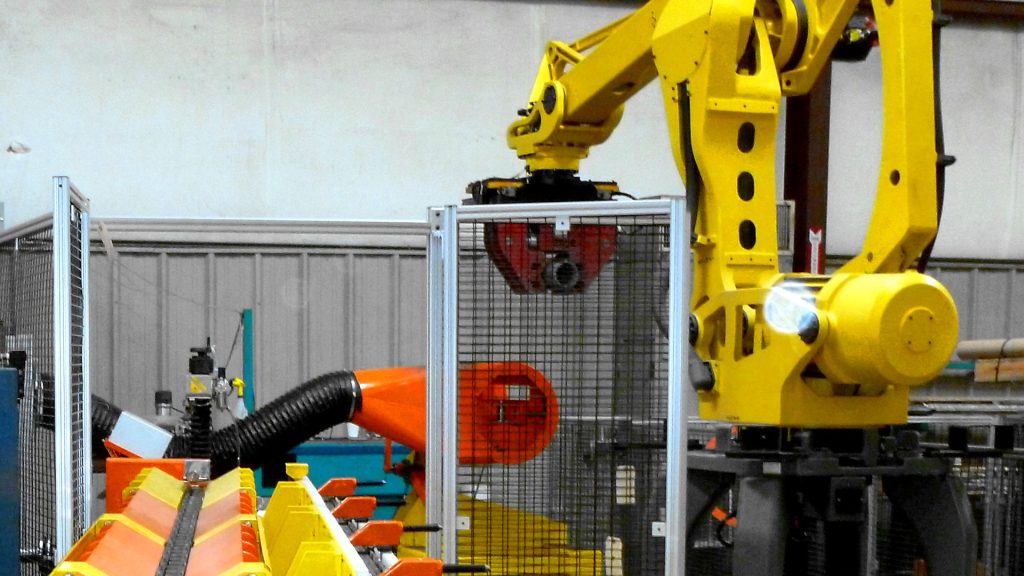
Keep machines productive with consistent robotic handling
Sage begins by documenting the machine cycle, part presentation, placement tolerances, operator tasks and recovery conditions. That information determines robot reach, tooling design, fixture requirements and the amount of buffering needed between operations.
The system can include incoming part racks, conveyors, vision, gauging, marking and finished-part discharge. Sage develops the mechanical, electrical and software interfaces needed to coordinate the robot with existing or new machines.
Application data to define
- Machine availability signals
- Raw and finished part presentation
- Tool change or dual-grip requirements
- Part temperature and contamination
- Inspection and traceability data
- Operator replenishment and access
What the system can include
Repeatable machine interface
Robot paths, tooling and fixtures provide consistent loading and unloading at each process station.
Part identification
Sensors, vision and recipe controls can verify the product and select the correct handling sequence.
Integrated inspection
Gauging, presence checks and process results can be incorporated into the cell flow and traceability strategy.
Frequently asked questions
What machines can a robot tend?
Common examples include machining centers, presses, molding machines, test equipment and custom process stations. Feasibility depends on access, interfaces and part handling.
Can machine tending be added to older equipment?
Often, yes. Sage reviews the existing controls, safety circuit and mechanical access before defining required upgrades and interfaces.
Continue your application research
Bring us the application data.
Share the product, payload, rate, process sequence and available layout with a Sage applications engineer.