
Robot systems
Industrial Gantry Robot Manufacturer
Move heavy, bulky or difficult-to-handle products with a gantry robot engineered around your process. Sage Automation designs, manufactures and integrates custom Cartesian gantry robot systems for material handling, palletizing, and automated storage and retrieval.
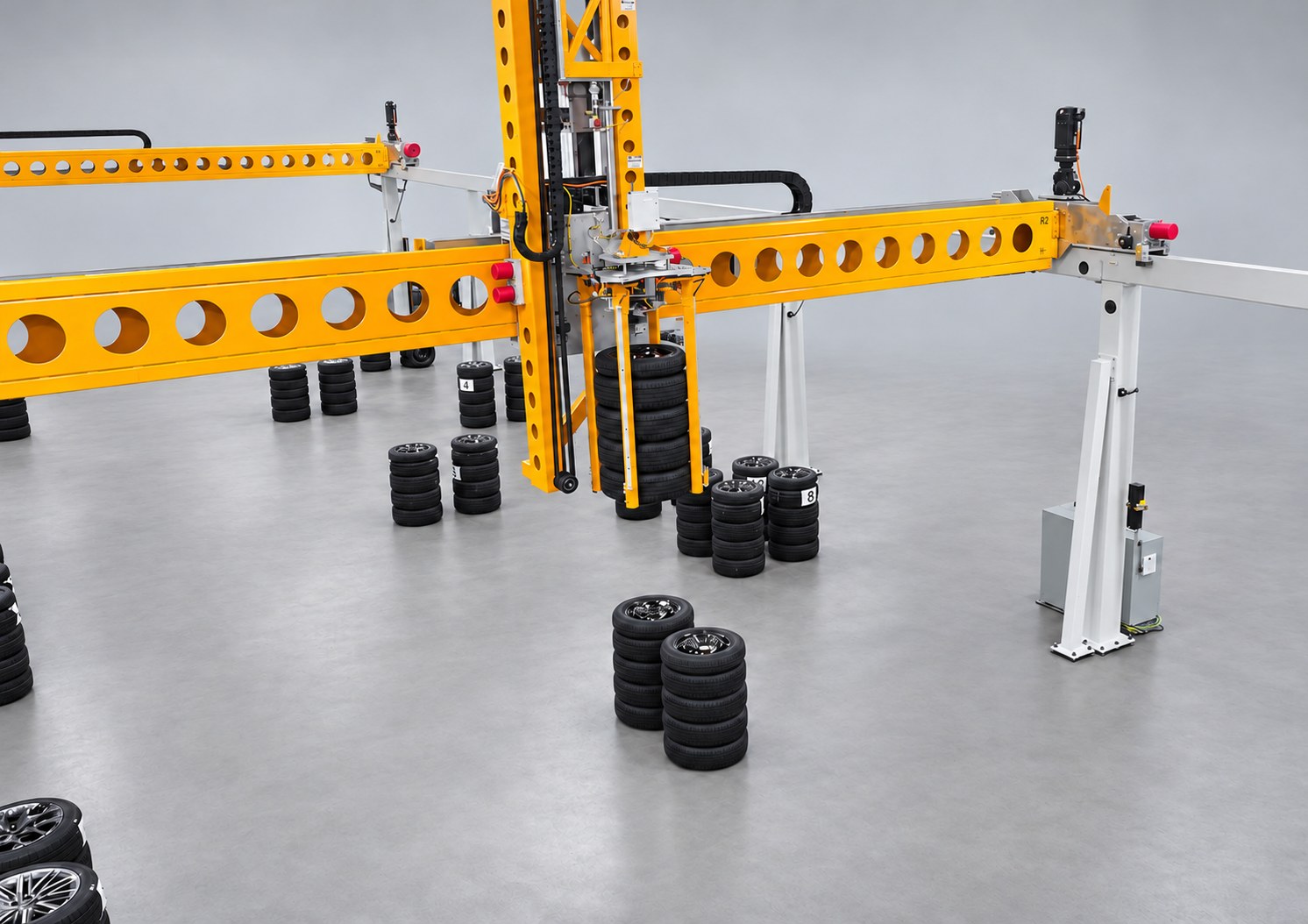
BUILT AROUND YOUR PRODUCTION REQUIREMENTS
One engineered system—from the gantry robot to the production line
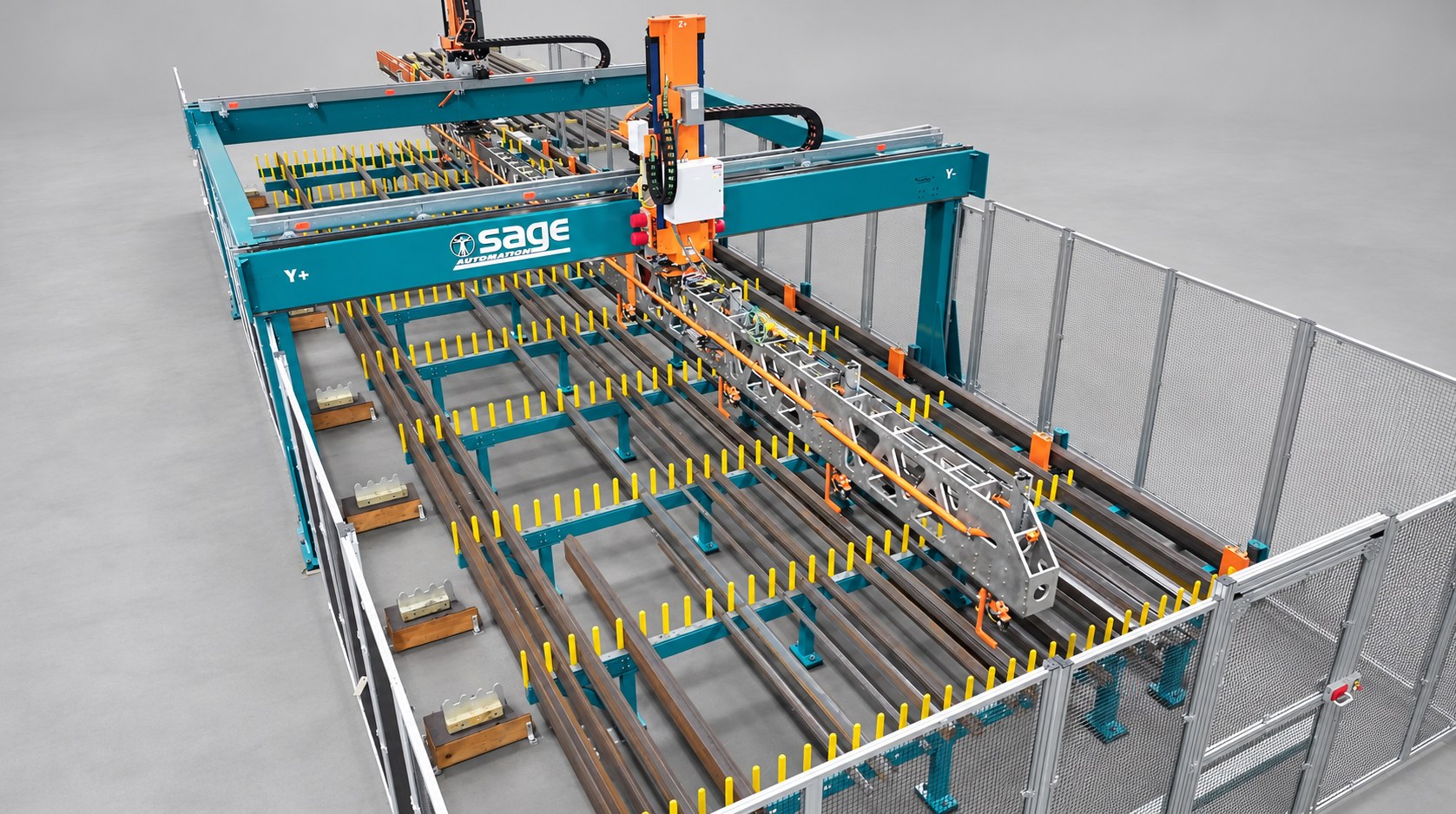
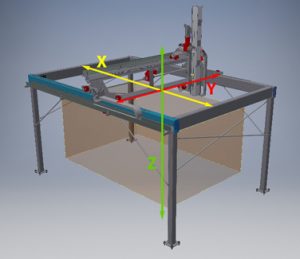
A gantry robot moves a tool or load along linear axes, commonly described as X, Y and Z. Its working envelope can span several pickup points, machines, conveyors or storage positions. Sage engineers the structure, motion, tooling and controls together for the application.
Discuss My Gantry Robot Application See Sage project examples ↓
Gantry robot automation engineered around your product
A Sage gantry robot is a coordinated machine, not a catalog arm mounted over a process. The bridge, trolley, vertical axis, end-of-arm tooling, controls, safety system and material flow are engineered together around payload, reach, accuracy and production requirements.
Gantry robot platforms are especially effective when a system must cover multiple machines, storage positions or process stations while keeping the floor below available for production. Sage designs, fabricates, programs, installs and services the complete system from one accountable engineering team.
Application data to define
- Payload and center of gravity
- Required X, Y and Z travel
- Throughput and motion profile
- Building, floor and support conditions
- Product variation and gripping method
- Maintenance access and recovery strategy
What your gantry robot system can include
Large working envelopes
Long X, Y and Z travel can connect multiple operations, storage locations and load stations with one coordinated platform.
Heavy and awkward payloads
Structural members, drives and tooling are sized for the actual product weight, center of gravity and dynamic loading.
Custom mechanical design
Sage engineers the gantry structure, gripper, conveyors, controls and guarding as an integrated production machine.
Sage project examples
Gantry robot applications in production
These examples from Sage’s project library show how product characteristics and process requirements shape the gantry, tooling and surrounding equipment.
Newspaper insert palletizing
Sage designed, built and programmed an open-gantry robot system to palletize stacks of loose, slippery newspaper coupon inserts onto wood pallets. The system also picks and places slip sheets used as moisture barriers.
The application brings product handling, pallet building and slip-sheet placement into one gantry robot system. The stack and sheet-handling requirements determine the tooling and sequence.
Tire and wheel storage & retrieval
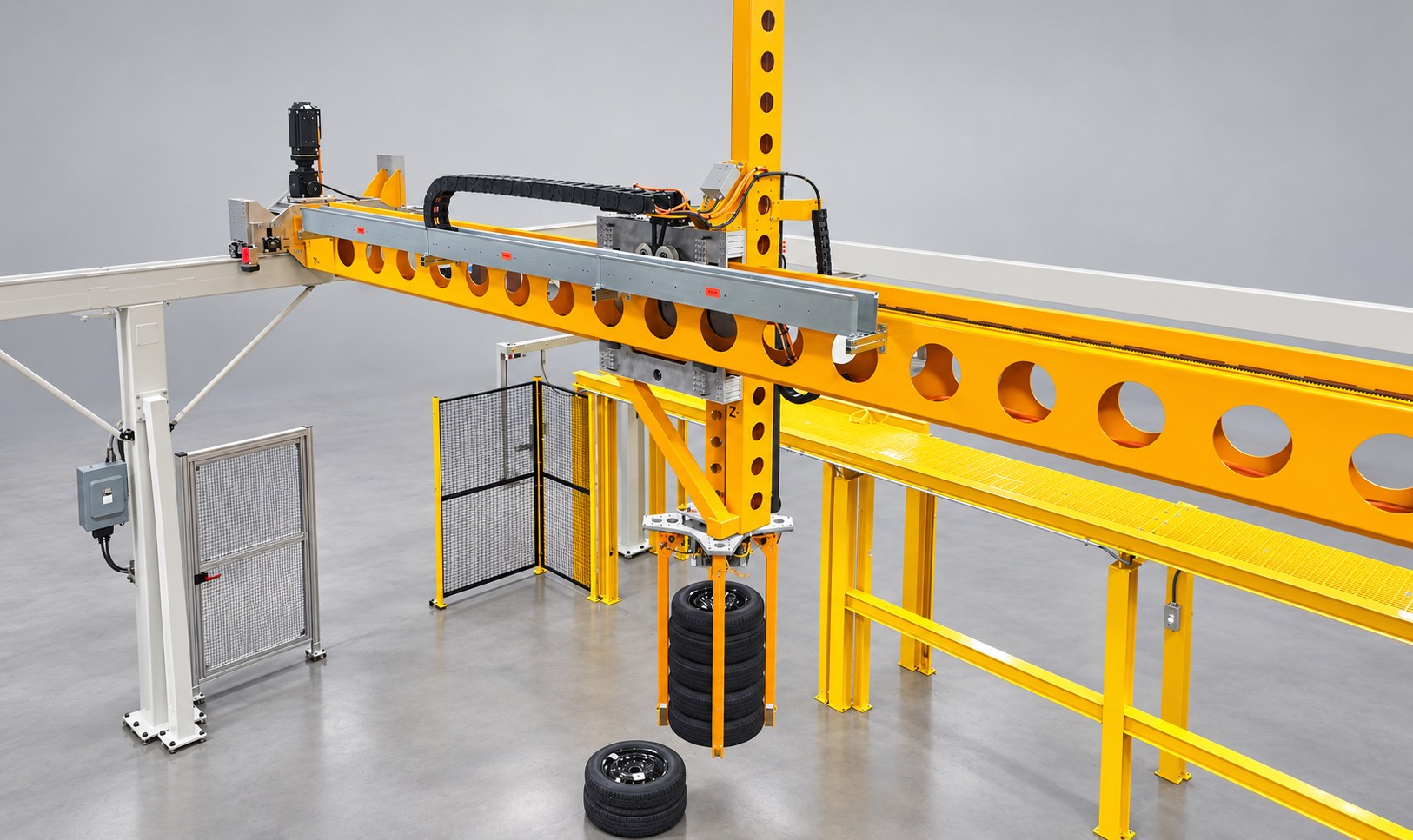
Sage has deployed gantry robot automated storage and retrieval systems for tire handling at Tire and Wheel Assembly suppliers serving automotive production plants. These systems store and retrieve tires as part of the manufacturing and distribution flow.
Sage’s published application material describes integration with tire mounting and balancing processes, factory controls and other robotic equipment. The project library below includes a tire and wheel AS/RS demonstration.
Shafted-roll handling
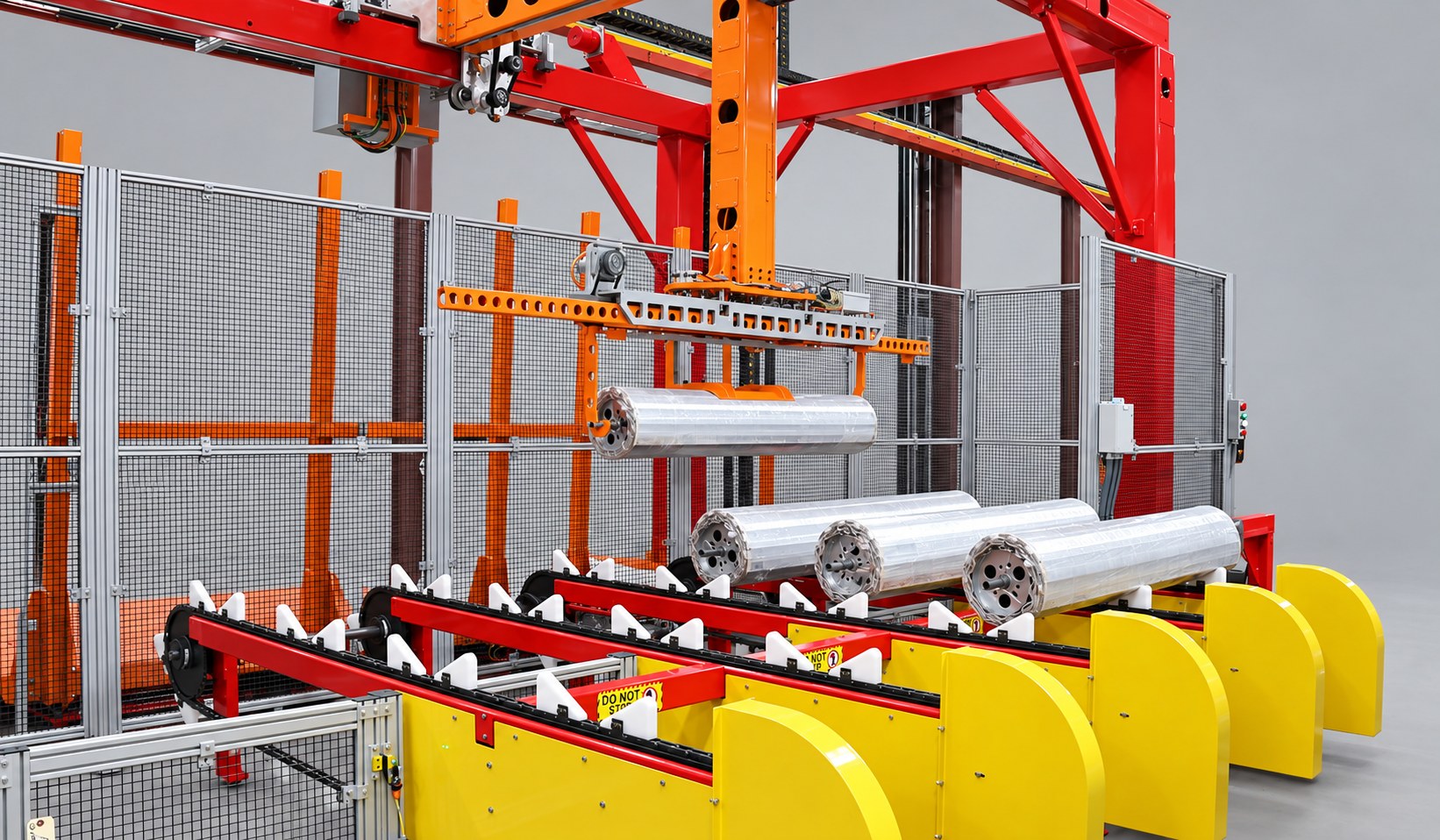
In a documented Sage roll-handling application, a gantry robot with J-hooks picks up a large roll by its shaft and places it onto an upender next to a shaft extractor. After shaft removal, the roll is upended and transferred to a conveyor.
This application combines the gantry, roll tooling, shaft extraction, upending and conveyor transfer. Those equipment interfaces are part of the complete handling sequence.
What is a gantry robot?
A gantry robot is an automated industrial system also known as a Cartesian robot or linear robot. Linear motion along perpendicular axes creates a rectangular working envelope. The X and Y axes define the horizontal working plane; the Z axis provides the vertical travel needed to pick up, move and place a product or tool.
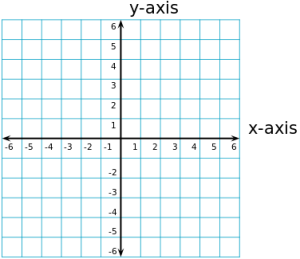
The number and arrangement of axes depend on the task. A common configuration adds a fourth rotational axis, often called U, below the Z beam to rotate the end-of-arm tool in the horizontal plane. Other tooling arrangements can provide vertical rotation when the application requires a different product orientation.
Guide systems and mechanical drives
Sage gantry designs use different guide systems and drive methods to suit the load, travel and operating requirements. Guide systems include wheel-and-track, profile rail and wheel-and-beam arrangements. Drive methods used in Sage designs include belt, wire rope, tractor, chain and closed-loop friction drives. The appropriate combination depends on the complete motion and handling requirements.
Gantry robots and overhead cranes
A gantry robot can resemble an overhead crane, but its purpose is coordinated, repeatable automation within a defined workcell. A rigid mechanical Z axis can control the tool and load differently from a suspended cable or rope hoist. The distinction depends on the actual equipment: cranes can also be automated, and payload, deflection, repeatability and safety requirements must be evaluated for each system.
When should you use an industrial gantry robot?
Consider a gantry robot when a large or heavy product needs controlled handling, or when the process spans a large working area. A gantry can connect multiple pickup points, production stations, pallet positions or storage locations. Repetitive handling is another reason to evaluate automation, particularly where the process can reduce manual lifting and allow employees to focus on other production and quality tasks.
Sage’s original gantry product descriptions covered systems ranging from room-sized footprints to very large working envelopes, and payloads ranging from a few pounds to several tons. These describe the breadth of custom applications rather than a single standard machine rating. Available span, payload, speed and travel must be established together for your product, building and process.
Custom gantry robot designs
Sage has described its gantry designs in six broad categories: light payload, light/medium payload, standard payload, heavy payload, extra-heavy payload and large-area systems. These are starting points for application engineering. A compact footprint can still require heavy-load handling; a large working envelope may serve many locations with relatively light products.
Common applications include pick and place, palletizing, depalletizing, machine loading and unloading, in-process transfer, end-of-line automation, material handling, machine tending, sortation, storage and packaging.
Multi-line palletizing with gantry robots
Multi-line palletizing systems build pallet loads for several product streams within a coordinated work area. Products may arrive on individual conveyors dedicated to each production line, or on a shared trunk conveyor carrying multiple products. When a shared line is used, sortation equipment can divert products into designated lanes for palletizing.
The gantry robot receives product information for each lane and follows the appropriate pallet pattern. The engineering task includes coordinating product arrival, pickup positions, pallet-building locations and completed-load removal. The gantry’s travel can reach multiple infeed lanes and pallet positions with one robotic head, subject to the required cycle time and production balance.
A fixed articulated robot has a working envelope determined by its reach and mounting position. A gantry provides another approach where production lines or pallet positions are spread across a larger area. An articulated robot on a linear travel axis is also an option. Sage evaluates the layout, product, tooling and throughput when selecting a platform.
Explore robotic palletizing systems →
Gantry robot automated storage and retrieval systems (AS/RS)
The space within a gantry can serve as temporary storage, accumulation or a buffer between production processes. Storage duration and retrieval sequences depend on product demand, production rates and the downstream operation. The gantry robot moves products between assigned locations and transfer stations within its working envelope.
Storage-management databases can track product identity, location and storage time, supporting first-in, first-out (FIFO) flow where required. Retrieval rules can prioritize particular SKUs or release space for incoming products. Compatible products may be grouped into a single pick or stored in adjacent positions to improve handling efficiency, depending on the tooling and load characteristics.
For large or heavy products that are difficult to accommodate in conventional rack arrangements, a gantry-based AS/RS can provide an alternative. Floor loading, storage density, access, recovery procedures and required throughput all influence the design. Sage’s project library includes tire and wheel handling, dairy tote or milk-crate storage, and tote-and-barrel applications.
Explore automated storage and retrieval →
Other gantry robot handling applications
The original Sage library also demonstrated pipe and tube bundling with a compact heavy-product gantry, open-gantry tire handling, and end-of-line tire storage and palletizing. These applications illustrate how footprint, payload and handling sequence can lead to different gantry configurations.
Unsure which configuration fits? Describe the product, the pickup and placement locations, and the desired production rate. Sage’s applications team can help evaluate whether a gantry is appropriate.
Project video library
See related Sage systems in operation
Related project images
Frequently asked questions
When is a gantry robot better than an articulated robot?
A gantry is often the stronger choice for very large rectangular work areas, long travel, multiple machine positions or unusually heavy and bulky loads. Sage evaluates both platforms before recommending a system.
Does Sage manufacture the complete gantry robot system?
Yes. Sage designs and manufactures the gantry platform and integrates tooling, controls, conveyance, safety equipment, programming, installation and lifecycle service.
Continue your application research
Let’s talk about your gantry robot application.
Start with what you know: the product you handle, the task you want to automate and your target production rate. You do not need a completed specification to begin the conversation.
Discuss your gantry robot application
Tell us what you need to move and what you want to improve. Include product weight, travel distance and production rate if available; estimates are welcome. Sage’s applications team can help define the next engineering questions.
Prefer to talk? Call 800-731-9111 or email sales@sagerobot.com.
After you inquire, Sage reviews the application and follows up to discuss requirements and next steps. Please use the initial message to describe your project; drawings and confidential files can be coordinated directly with the team.